News · Het Financieele Dagblad — The Future of Mobility · November 2026
The truck can drive itself, but who handles the rest?
In the FD supplement on the future of mobility, Richard Matthijsse and Nilaksha Das explain why Europe’s driver shortage demands logistics sites ready for autonomous vehicles.

A transport company needs 40 drivers but often starts the workday with only 32. Job openings remain unfilled for weeks, and new employees sometimes leave within just two months. These are examples that Richard Matthijsse, founder and CEO of NAVIS Solutions, knows all too well. “We’ve been working on autonomous vehicles for years and have learned that the technology is rarely the biggest problem. The real challenge is making those vehicles function within the context of daily logistics operations. Far too little thought is being given to that.”
A ticking time bomb
According to the International Road Transport Union (IRU), Europe has approximately 502,000 unfilled truck driver positions. Moreover, a significant portion of the workforce will reach retirement age in the coming years. Nilaksha Das, co-founder and program manager at NAVIS Solutions, sees the consequences extending beyond the transportation sector. “Just look around you. Virtually everything you see was once transported. Logistics keeps our society running. If we don’t have enough people to move goods, it will ultimately affect everyone. We simply cannot afford to wait and see.”
According to Matthijsse, the focus is primarily on the spectacular possibilities of self-driving vehicles. “Everyone is familiar with the images of robotaxis driving through American cities without a driver, but logistics is much more complicated. Not only must a truck be able to drive autonomously, but at a distribution center, trailers must be located, loading docks must be available, and the flow of goods must be coordinated. If one link in the chain breaks down, it can throw everything off track.”
Start with the people
Matthijsse founded NAVIS Solutions with his partners in late 2025 in response to these developments. The company has consciously opted for a gradual transition to autonomous logistics. Das: “We start with the people who are doing the work today. They waste a lot of time searching, waiting, and correcting errors. By organizing those processes more intelligently, we make their work easier and increase productivity at the same time. As employees retire, autonomous systems can take over more and more tasks.”
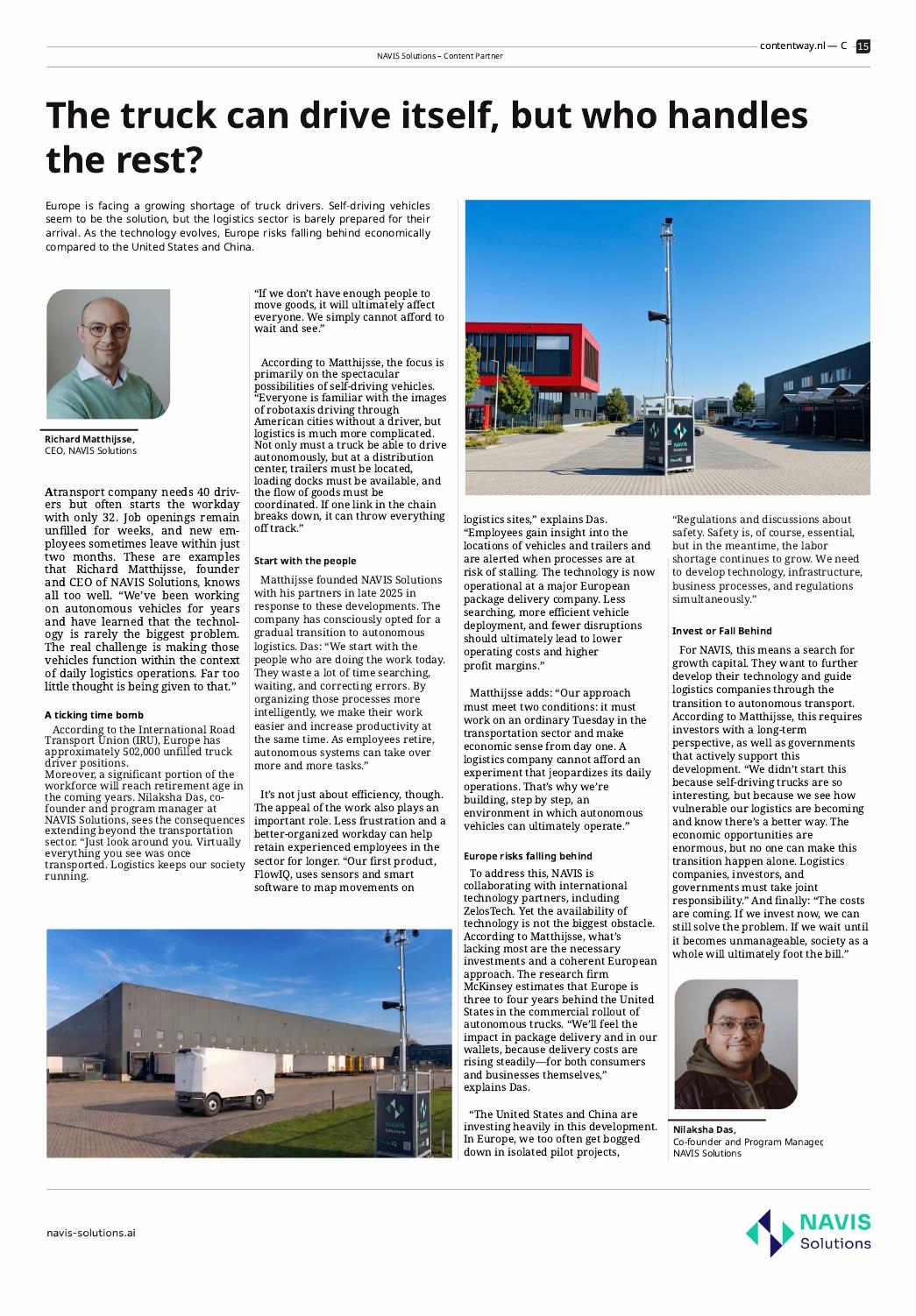
It’s not just about efficiency, though. The appeal of the work also plays an important role. Less frustration and a better-organized workday can help retain experienced employees in the sector for longer. “Our first product, FlowIQ, uses sensors and smart software to map movements on logistics sites,” explains Das. “Employees gain insight into the locations of vehicles and trailers and are alerted when processes are at risk of stalling. The technology is now operational at a major European package delivery company. Less searching, more efficient vehicle deployment, and fewer disruptions should ultimately lead to lower operating costs and higher profit margins.”
Matthijsse adds: “Our approach must meet two conditions: it must work on an ordinary Tuesday in the transportation sector and make economic sense from day one. A logistics company cannot afford an experiment that jeopardizes its daily operations. That’s why we’re building, step by step, an environment in which autonomous vehicles can ultimately operate.”
Europe risks falling behind
To address this, NAVIS is collaborating with international technology partners, including ZelosTech. Yet the availability of technology is not the biggest obstacle. According to Matthijsse, what’s lacking most are the necessary investments and a coherent European approach. The research firm McKinsey estimates that Europe is three to four years behind the United States in the commercial rollout of autonomous trucks. “We’ll feel the impact in package delivery and in our wallets, because delivery costs are rising steadily—for both consumers and businesses themselves,” explains Das.
“The United States and China are investing heavily in this development. In Europe, we too often get bogged down in isolated pilot projects, regulations and discussions about safety. Safety is, of course, essential, but in the meantime, the labor shortage continues to grow. We need to develop technology, infrastructure, business processes, and regulations simultaneously.”
Invest or fall behind
For NAVIS, this means a search for growth capital. They want to further develop their technology and guide logistics companies through the transition to autonomous transport. According to Matthijsse, this requires investors with a long-term perspective, as well as governments that actively support this development. “We didn’t start this because self-driving trucks are so interesting, but because we see how vulnerable our logistics are becoming and know there’s a better way. The economic opportunities are enormous, but no one can make this transition happen alone. Logistics companies, investors, and governments must take joint responsibility.”
And finally: “The costs are coming. If we invest now, we can still solve the problem. If we wait until it becomes unmanageable, society as a whole will ultimately foot the bill.”