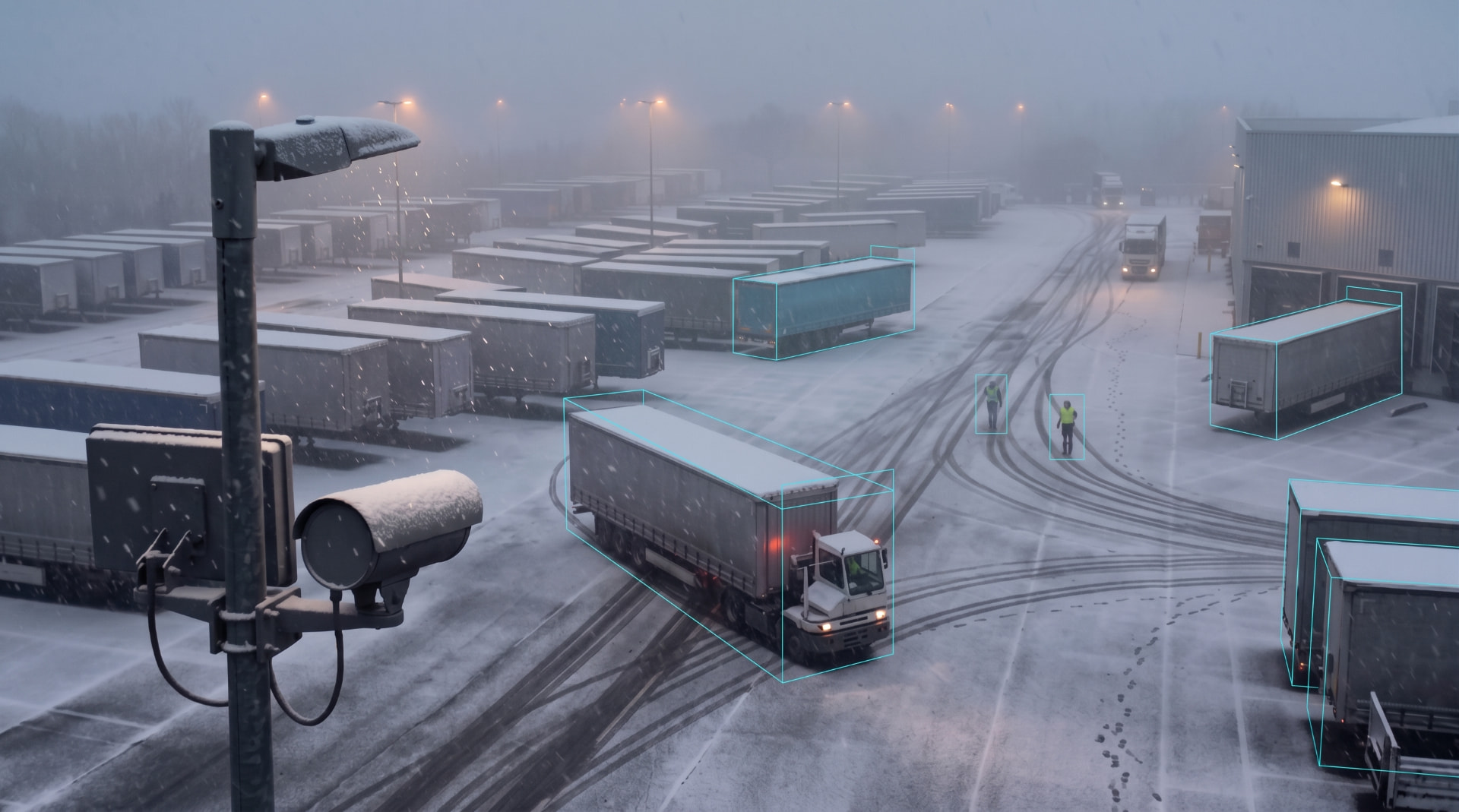
Logistics yards are still full of blind spots. Operators often rely on a mix of systems, manual checks and local knowledge to understand where trailers, swap bodies and containers are, what has moved and what needs attention.
But the yard does not operate on its own. The yard and the warehouse are two parts of the same operation, and together they form one link in the wider supply chain. A missing trailer or swap body, a queue at the gate or a dock that is not ready quickly becomes a bottleneck for the whole site.
The two sides are closely linked across six areas:
Flow & throughput
Keep units moving and avoid yard bottlenecks.
Fleet & labour efficiency
Reduce wasted moves, waiting and manual effort.
Infrastructure utilisation
Use docks, space and equipment more effectively.
Service & reliability
Protect on-time delivery and operational consistency.
Safety & risk
Detect near misses and reduce repeat risks.
Sustainability & ESG
Cut idling, waste, energy use and emissions.
Many sites are not achieving the throughput, space utilisation or resource productivity they are capable of because yard and warehouse operations are still managed separately.
This is the problem FlowIQ is built to solve: creating the ground truth needed to connect what is happening on the yard with the wider operation.
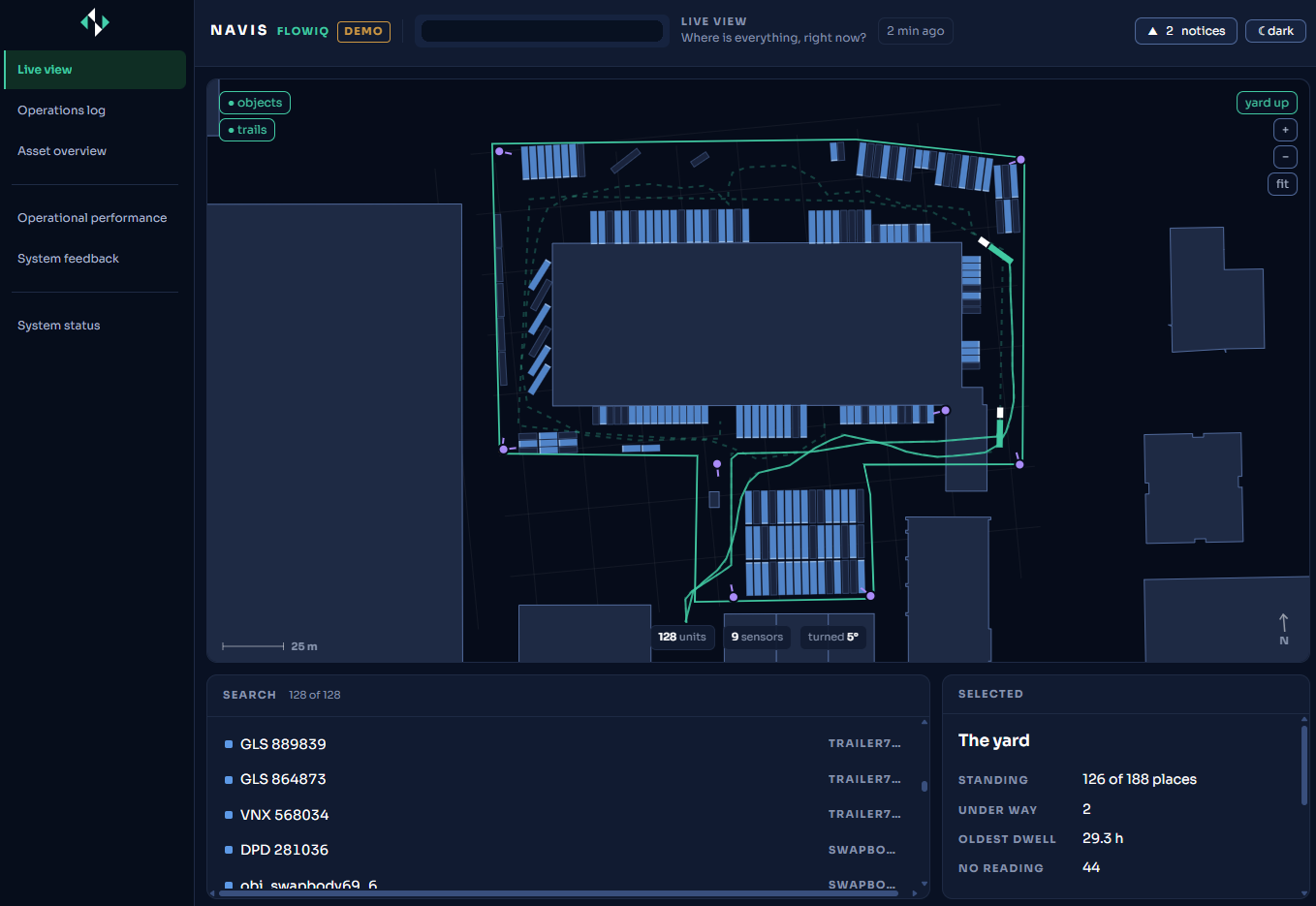
FlowIQ identifies every trailer, swap body and other asset on the yard, and tracks everything happening around them.
FlowIQ sees the yard in its entirety, around the clock. It continuously tracks every vehicle and asset, with particular focus on trailers, swap bodies and containers, while also capturing the movement of people without identifying individuals.
That ground truth gives operators an accurate view of what is actually happening across the yard. FlowIQ can compare planned activity with reality, support slot planning by helping decide which parking or dock position each unit should use based on what is happening and what needs to happen next, and trigger safety alerts when people or vehicles enter potentially unsafe situations.
FlowIQ also provides daily operations support functions for the shift manager, including live unit counts, ID look-up, dwell-time and queue tracking, utilisation views, delay and exception alerts, near-miss reporting and operational KPI reporting.
It is not a Yard Management System (YMS). It is the layer that tells the YMS whether what it planned is actually happening, what has changed and what should happen next.
Where is it?
A driver walks the yard with a torch, looking for one trailer or swap body.
Does the system match the yard?
The Yard Management System (YMS) says slot 14, but the trailer is in slot 31. Nobody knows until something goes wrong.
What is actually on site?
The yard is counted by hand once or twice a day. The information can already be out of date by the time the count is finished.
What happened to that trailer?
Damage is found later, with no clear record of when or where it happened.
What almost went wrong?
A shunter passes too close to a pedestrian. Nobody reports it, so the same situation can happen again.
Where should it go?
The shift planner picks a slot from habit, the trailer ends up on the far side of the yard from its dock, and every move to and from it takes longer than it should.
How a sensor on a mast
becomes a decision on the yard.
Five steps take FlowIQ from raw sensor data to information the shift manager can act on.
01
Sense
Camera sensors capture, and then classify and identify everything that is happening across the yard, always.
02
Understand
FlowIQ quantifies the observed operation through tracked KPIs such as vehicle waiting time, asset dwell time, and yard throughput, among others, and makes that operational picture available to shift managers.
03
Check
FlowIQ compares what is actually happening on the yard with what the Yard Management System (YMS) planned, and flags any mismatch as soon as it appears.
04
Act
FlowIQ shows the shift manager what needs attention first. That could be a swap body in the wrong slot, a near miss, a bay that should be empty or another issue that could disrupt the operation.
05
Improve
FlowIQ suggests where each unit should go, which route the shunter should take and which dock is most suitable. The shift manager makes the decision, and FlowIQ learns from what happens to improve the next suggestion.
Priced as hardware for the sensor masts plus an annual licence per site.
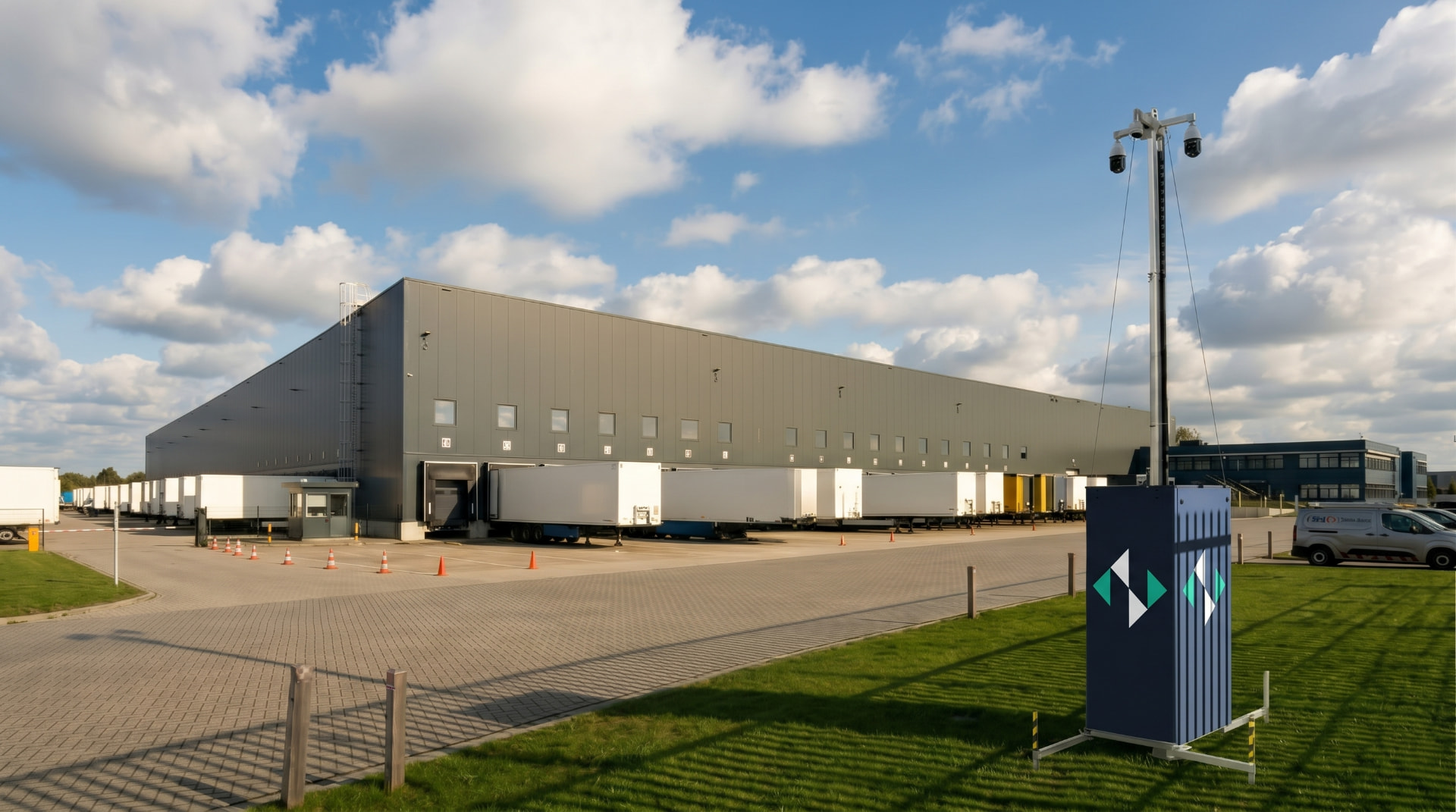
FlowIQ goes live at its first site in November 2026, in time for peak.
The first pilot runs through the busiest weeks a parcel yard has, from Black Friday to Christmas, and a limited number of pilots follow at other sites in 2027. Get on the list.